
Where The CFO-TA Fits in the Enterprise AI Stack
Most organizations today are investing in AI governance, AI platforms, agent frameworks, automation, and enterprise applications. These investments are important. Leading organizations also address a more fundamental question:
What business outcomes are these systems expected to achieve?
The CFO-TA is the Executive Sponsor Platform. It is a Business-Side platform purpose-built to help Executive Sponsors govern their three Sponsor-owned responsibilities: Business Intent, Scope Intent, and Transformation Approach Intent. Together, these form Sponsor Intent, the Executive Sponsor-owned expression of purpose and foundation of the Transformation Definition.
The CFO-TA governs the Sponsor Intent that Transformation Programs, AI systems, enterprise applications, implementation partners, and business operations are expected to deliver. It equips and guides Executive Sponsors and Sponsor Teams through the guidance, methodology, authoring, analysis, deliverable production, validation, review, coordination, decision support, and governed workflows required to establish, govern, validate, monitor, improve, and prove that intent.
As organizations adopt increasingly autonomous technologies, maintaining alignment between Sponsor Intent and operational execution becomes one of the most important governance challenges they face. The CFO-TA and Sponsor Intent Lifecycle Management Studio, or SILMS, provide a structured operating model for establishing and governing Sponsor Intent before operations begin and throughout the Transformation Program lifecycle. The CFO-TA equips and guides leadership, while SILMS preserves the authoritative and governed memory of enterprise purpose on the client’s infrastructure. Together, they maintain continuity between what leadership authorized and what systems, partners, people, and AI ultimately deliver.

The Challenge Most Enterprise AI Architectures Do Not Address
Most enterprise AI architectures begin with governance, control frameworks, AI platforms, agents, workflows, or infrastructure. While these capabilities are essential, they typically assume the organization has already established a clear definition of success.
In reality, many Transformation Programs operate with business objectives that exist across executive conversations, presentations, requirements documents, Transformation Program plans, governance meetings, spreadsheets, and institutional memory. Different stakeholders often believe they are pursuing the same objective while relying on different assumptions regarding priorities, tradeoffs, accountability, and success criteria.
AI accelerates the consequences of ambiguous intent by scaling decisions and actions across the enterprise. The more capable organizations become at operations, the more important it becomes to explicitly define what those operations are expected to achieve.
Understanding The Enterprise AI Stack
A practical Enterprise AI Stack consists of several distinct layers, each serving a different purpose.
At the top are Business Outcomes, representing what leadership ultimately intends to achieve. These outcomes provide direction for the organization and establish the reason automation, transformation, and technology investments exist.
Directly beneath Business Outcomes sits The CFO-TA, the Executive Sponsor Platform. This is where Executive Sponsors and Sponsor Teams apply Business Intent Design to translate strategic intent into explicit, governable Sponsor Intent before it becomes AI governance policy, control-plane configuration, agent behavior, application logic, operational activity, or evidence.
Business Intent Design is the missing discipline that helps Executive Sponsors translate strategic intent into explicit, governable Sponsor Intent, creating the foundation required to guide decisions, shape contractual commitments, preserve alignment, and govern delivery across the Transformation Program lifecycle. Sponsor Intent is formed by Business Intent, Scope Intent, and Transformation Approach Intent. The CFO-TA equips and guides Executive Sponsors and Sponsor Teams as they establish, govern, validate, monitor, improve, and prove Sponsor Intent across the Transformation Program lifecycle and ongoing operations.
SILMS serves as the initial implementation of the Enterprise Intent Authority Layer. It preserves Sponsor Intent Assets, Conditions of Success, Decision Boundaries, Accountability Requirements, Evidence Requirements, tradeoff priorities, validation requirements, related Sponsor-Owned Assets, and their governed history on the client’s infrastructure. Together, The CFO-TA and SILMS convert leadership purpose into a durable source of authority from which governance policies, control-plane configurations, operational constraints, validation activities, monitoring activities, and downstream consumption structures can be derived.
Below the Enterprise Intent Authority Layer sits AI Governance. AI Governance establishes the policies, controls, risk requirements, compliance obligations, approvals, and oversight mechanisms that govern AI-enabled behavior.
Next comes the AI Control Plane. The control plane enforces governance policies during execution, ensuring agent activity, workflows, and automated decisions remain within approved boundaries.
Below the control plane are AI Agents and Orchestration platforms that perform work, make recommendations, trigger actions, and coordinate activities across systems.
These agents interact with Enterprise Processes and Applications such as ERP, CRM, analytics, service management, and operational platforms.
At the bottom of the stack is Operations and Evidence, where actual business activities, decisions, transactions, and measurable outcomes occur. Each layer depends on the authoritative direction and governed structures established above it.
The CFO-TA occupies the critical position where Executive Sponsor intent becomes explicit, testable, governable, measurable, and operationally durable. SILMS preserves the resulting Sponsor Intent and Sponsor-Owned Assets as the authoritative and governed memory of enterprise purpose.
The Enterprise Intent Authority Layer
The Enterprise Intent Authority Layer is the authoritative and governed memory of enterprise purpose. It preserves the Strategic Intent, Sponsor Intent, Business Intent, Scope Intent, Transformation Approach Intent, Conditions of Success, Decision Boundaries, Accountability Requirements, Validation Requirements, Evidence Requirements, and intent history that define what leadership intends to achieve and how success will be judged.
For the initial launch, SILMS instantiates this layer on the client’s infrastructure. The CFO-TA provides the Executive Sponsor experience and Alentra-Authored Intelligence through which Sponsor Intent is developed, governed, validated, monitored, improved, and proven. SILMS preserves the resulting client-specific Sponsor Intent, Sponsor-Owned Assets, relationships, decisions, validation records, evidence, and intent evolution as a durable source of authority.
The Enterprise Intent Authority Layer answers five fundamental questions:
-
What are we trying to achieve?
-
Why are we trying to achieve it?
-
How will success be determined?
-
What boundaries must be respected?
-
How has intent evolved over time?
This separation allows enterprise purpose to remain persistent as people, vendors, PIAs, applications, AI platforms, agents, operational structures, and implementation approaches evolve. Downstream governance and operations consume governed Sponsor Intent while the Executive Sponsor and Sponsor Team retain ownership and authority.
Why The CFO-TA Operates Above AI Governance
Intent Governance is the upstream governance discipline that governs purpose. AI Governance is an Execution Governance discipline that governs AI-enabled behavior through policies, controls, risk requirements, approvals, and oversight.
AI Governance answers questions such as:
-
What policies apply?
-
What controls are required?
-
What risks must be managed?
-
What approvals are necessary?
-
What activities are permitted?
The CFO-TA addresses the Sponsor-owned questions that give those governance mechanisms their direction:
-
What are we trying to achieve?
-
What outcomes matter most?
-
What tradeoffs are acceptable?
-
What conditions must remain true?
-
What evidence will demonstrate success?
-
Who owns the outcome?
The CFO-TA operates above AI Governance because Executive Sponsors must first define the outcomes, boundaries, accountabilities, evidence requirements, and decision priorities that governance mechanisms are expected to protect. Business Intent Design provides the discipline for translating strategic intent into explicit, governable Sponsor Intent, while SILMS preserves the resulting authority and organizational memory on the client’s infrastructure.
AI Governance governs behavior through policies, controls, risks, approvals, and oversight. The CFO-TA operationalizes Intent Governance by helping the Executive Sponsor govern the purpose that AI Governance and other Execution Governance mechanisms are expected to protect.
Intent Governance governs purpose. Execution Governance governs behavior. Organizations require both.
Why The CFO-TA Operates Above AI Control Planes
AI Control Planes play a critical role in modern enterprise architectures. They enforce runtime controls across AI models, agents, workflows, and automation platforms. They help ensure policies are applied consistently and that operations remain within approved governance boundaries.
AI Control Planes enforce the policies, permissions, and runtime boundaries they receive. The Enterprise Intent Authority Layer supplies the authoritative purpose, outcome priorities, Decision Boundaries, Accountability Requirements, Validation Requirements, and evidence model that inform those downstream controls.
The CFO-TA establishes and governs the Sponsor Intent framework that informs AI Governance, control-plane configuration, validation activities, monitoring processes, and continuous improvement. SILMS preserves that framework and its governed history, giving downstream controls a durable source of what leadership authorized and how success will be evaluated.
The relationship is complementary. The CFO-TA governs intent while the control plane enforces execution controls. Together they connect Sponsor-authorized purpose with governed operational behavior.
What The CFO-TA Actually Governs
The CFO-TA governs Sponsor Intent and the alignment between intended outcomes and delivered outcomes. Intent Governance focuses on preserving the purpose, priorities, boundaries, accountability expectations, and evidence requirements authorized by the Executive Sponsor throughout the Transformation Program lifecycle and ongoing operations.
This distinction is important.
The platform helps organizations define and manage:
-
Business Outcomes
-
Conditions of Success
-
Decision Boundaries
-
Accountability Requirements
-
Evidence Requirements
-
Tradeoff Priorities
-
Validation Requirements
-
Monitoring Requirements
-
Improvement Opportunities
These elements become governed Sponsor-Owned Assets that express what leadership intended and provide the foundation for governance throughout the Transformation Program lifecycle and ongoing operations. The CFO-TA gives the Executive Sponsor and Sponsor Team the guidance, methodology, authoring, analysis, validation, review, coordination, and decision-support capabilities required to develop and govern those assets.
The CFO-TA governs alignment between intended outcomes and delivered outcomes. It governs whether the outcomes leadership authorized remain intact as strategy becomes Solution Selection, Solution Selection becomes implementation, implementation becomes operations, and operations become increasingly AI-enabled.
SILMS serves as the initial implementation of the Enterprise Intent Authority Layer. It stores and governs Sponsor Intent Assets, related Sponsor-Owned Assets, asset relationships, evidence, validation history, reviews, decisions, intent evolution, and organizational memory on the client’s infrastructure. A governed artifact chain operationalizes Sponsor Intent so it remains explicit, referenceable, traceable, validatable, and durable as operations move across people, systems, partners, workflows, automation platforms, and AI agents.
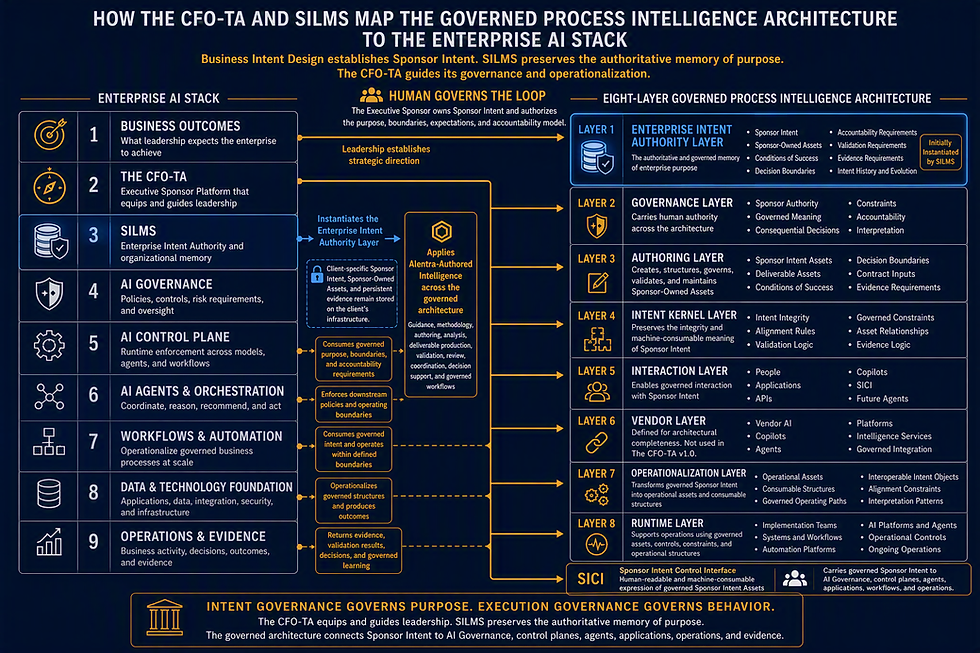
How the Eight-Layer Governed Process Intelligence Architecture Supports the Enterprise AI Stack
The Eight-Layer Governed Process Intelligence Architecture operationalizes Business Intent Design and Intent Governance within the Enterprise AI Stack. Layer 1, the Enterprise Intent Authority Layer, preserves the authoritative and governed memory of enterprise purpose. For the initial launch, SILMS instantiates Layer 1, while The CFO-TA applies Alentra-Authored Intelligence across the remaining instantiated layers to guide authoring, governance, analysis, validation, operationalization, and downstream consumption of Sponsor Intent.
The complete architecture consists of:
-
Layer 1: Enterprise Intent Authority Layer
-
Layer 2: Governance Layer
-
Layer 3: Authoring Layer
-
Layer 4: Intent Kernel Layer
-
Layer 5: Interaction Layer
-
Layer 6: Vendor Layer
-
Layer 7: Operationalization Layer
-
Layer 8: Runtime Layer
Together, the eight layers provide the structure used by The CFO-TA and SILMS to establish, preserve, validate, monitor, improve, and prove Sponsor Intent throughout the Transformation Program lifecycle and ongoing operations. The Vendor Layer is defined for architectural completeness and future generations of the architecture and is not used in The CFO-TA v1.0.
The CFO-TA and Enterprise Transformation Programs
While this architecture is highly relevant for Agentic AI Transformation Programs, its applicability extends far beyond AI.
The same framework applies to:
-
ERP Transformation Programs
-
CRM Transformation Programs
-
Analytics Transformation Programs
-
Shared services modernization
-
Business process transformation
-
Digital transformation programs
-
AI-enabled operating models
-
Enterprise platform implementations
Any Transformation Program involving consequential business change depends on clear Sponsor Intent. The CFO-TA equips and guides Executive Sponsors as they establish, govern, validate, monitor, improve, and prove that intent. SILMS preserves the resulting Sponsor Intent and organizational memory, maintaining continuity among executive purpose, commercial commitments, implementation decisions, validation activities, and operational outcomes.
How The CFO-TA Creates Enterprise Alignment
Organizations often struggle with alignment because intent becomes fragmented over time. Different teams, vendors, implementation partners, business units, and technology groups gradually develop their own interpretations of success.
The CFO-TA provides the Business-Side operating environment through which the Executive Sponsor and Sponsor Team establish and govern Sponsor Intent. SILMS preserves that intent through the Enterprise Intent Authority Layer, creating an authoritative and durable reference for what leadership authorized, why it matters, which boundaries apply, and how success will be judged.
The Sponsor Intent Control Interface, or SICI, provides a human-readable and machine-consumable expression of governed Sponsor Intent Assets. It allows people, systems, workflows, automation platforms, AI platforms, and agents to consume Sponsor Intent consistently while SILMS maintains the authoritative assets, relationships, history, decisions, validation records, and evidence on the client’s infrastructure.
By making Sponsor Intent explicit, structured, governed, and measurable, organizations gain a practical mechanism for ensuring that people, systems, vendors, AI agents, workflows, and operational processes remain aligned with approved outcomes. This capability becomes increasingly valuable as organizations scale automation, distribute decision-making, and increase AI autonomy.
Why This Matters
As organizations deploy more AI capabilities, governance complexity continues to increase. New agents, models, automation platforms, and enterprise applications create additional operating paths, while AI accelerates decisions and actions at scale.
Increasing autonomy makes the authoritative and governed memory of enterprise purpose an essential enterprise capability. The CFO-TA gives Executive Sponsors the operating platform required to make Sponsor Intent explicit and governable. SILMS preserves that intent through the Enterprise Intent Authority Layer so downstream governance mechanisms, systems, partners, workflows, and AI agents remain connected to what leadership authorized.
Organizations that preserve alignment between Executive Sponsor intent and operational outcomes gain a durable advantage in governance, accountability, and Value Realization.
The CFO-TA Is the Executive Sponsor Platform
The CFO-TA is the Executive Sponsor Platform. It is a Business-Side platform purpose-built for Executive Sponsors responsible for major transformation investments. The platform combines Executive Sponsor insight, proven methodology, Alentra-Authored Intelligence, and AI-powered tools to equip and guide leadership throughout the Transformation Program lifecycle.
The platform helps Executive Sponsors govern their three Sponsor-owned responsibilities: Business Intent, Scope Intent, and Transformation Approach Intent. Together, these form Sponsor Intent, the Executive Sponsor-owned expression of purpose and foundation of the Transformation Definition.
Business Intent Design provides the discipline through which strategic intent is translated into explicit, governable Sponsor Intent, creating the foundation required to guide decisions, shape contractual commitments, preserve alignment, and govern delivery across the Transformation Program lifecycle.
SILMS serves as the initial implementation of the Enterprise Intent Authority Layer. It preserves the authoritative and governed memory of enterprise purpose that Transformation Programs, people, systems, vendors, workflows, automation platforms, and AI agents are expected to operationalize.
AI Governance platforms define policies, controls, risk requirements, and oversight mechanisms. Agent control planes enforce runtime behavior. The CFO-TA and SILMS establish, govern, preserve, validate, monitor, improve, and prove the Sponsor Intent those downstream mechanisms are expected to protect and enforce.
The CFO-TA operates upstream of AI Governance, AI Control Planes, agents, enterprise applications, and operational activity. It gives Executive Sponsors the operating environment required to make purpose, boundaries, accountabilities, expected outcomes, commercial implications, and evidence requirements explicit before they become governance policy, control-plane configuration, operational constraints, implementation decisions, or evidence.
The CFO-TA equips and guides leadership. SILMS preserves the authoritative memory of purpose. Downstream governance and operations consume governed Sponsor Intent. The Executive Sponsor governs the loop.
Next Steps
>> Read my Medium related article Agentic AI Has a Control Problem. Enterprises Have an Intent Problem.
>> Return to The CFO-TA Platform