
Start Your Engagement
A Structured Decision Path for Business-Side Leadership
Every organization begins from a different starting point. Some Executive Sponsors are evaluating a major Enterprise Transformation Program. Others are preparing for software selection, introducing AI-enabled capabilities, governing existing operations, or seeking greater confidence that their intended outcomes remain connected to business decisions. Across every situation, the Sponsor remains responsible for defining, governing, and preserving the purpose behind the investment.
The CFO-TA is the Executive Sponsor Platform. It helps Executive Sponsors govern the three Sponsor-owned responsibilities that shape every major transformation investment: Business Intent, Scope Intent, and Transformation Approach Intent. Together these form Sponsor Intent, the Executive Sponsor-owned expression of purpose and the foundation of the Transformation Definition.
This page outlines the available engagement paths, explains when each is appropriate, and helps Sponsors identify the right starting point based on their objectives, readiness, and desired level of support.
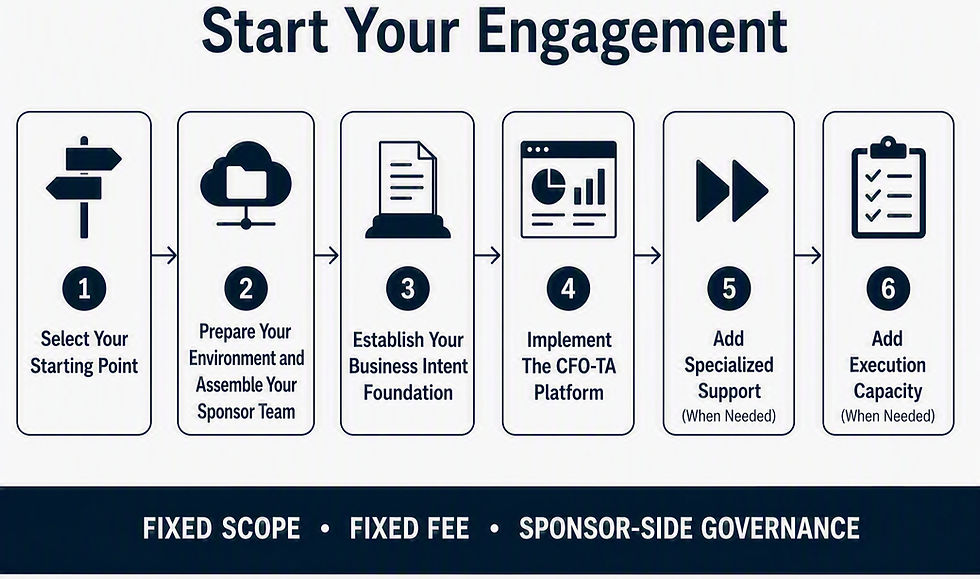
Step 1: Select Your Starting Point
Most organizations begin through one of three engagement paths.
The CFO-TA Trial
The CFO-TA Trial is the fastest way to experience the platform while producing meaningful business value. Delivered through Sponsor Intent Lifecycle Management Studio (SILMS) within the client's Microsoft environment, the Trial allows Sponsors and Business-Side leaders to establish, refine, validate, and govern Sponsor Intent Assets within one or more selected operating domains.
Organizations frequently begin with the Trial when they want hands-on experience with the platform before broader adoption. The Trial provides a practical introduction to Intent Governance while helping leadership create durable governance assets that continue to provide value well beyond the evaluation period.
Business Intent Design Accelerator
The Business Intent Design Accelerator is a consultant-led engagement designed to help Executive Sponsors make consequential Sponsor Intent explicit within a selected business domain. The engagement provides structured facilitation, challenge, guidance, and leadership support while helping Sponsors establish the Business Intent, Scope Intent, and Transformation Approach Intent that materially influence future decisions.
Organizations often choose this path when they want experienced Business-Side support while establishing a strong Sponsor Intent foundation, preparing for solution selection, evaluating transformation options, or addressing significant business change.
The CFO-TA Platform
Organizations that already understand the value proposition and are ready to establish an ongoing governance capability can move directly to The CFO-TA Platform.
The CFO-TA is a Copilot-based, AI-enabled Executive Sponsor Platform purpose-built to help Executive Sponsors govern Sponsor Intent throughout the Enterprise Transformation Program lifecycle and ongoing operations. It operationalizes Intent Governance while supporting Execution Governance through structured governance assets, workflow, guidance, validation, monitoring, improvement, and evidence-based decision support. The result is a durable governance capability that helps Sponsors maintain alignment between intended outcomes, business decisions, implementation activities, and operational reality.
Step 2: Prepare Your Environment and Assemble Your Sponsor Team
Organizations implementing The CFO-TA Platform or beginning The CFO-TA Trial prepare both the client’s Microsoft environment and the Business-Side team that will use the platform. Technical preparation includes confirming the Microsoft environment, validating SharePoint availability, verifying Copilot licensing requirements, establishing appropriate access and permissions, and identifying participating users.
The CFO-TA provides the Alentra-Authored Intelligence, guidance, methodology, Leadership Signals (Micro-Videos), AI-assisted authoring, analysis, decision support, validation support, and deliverable-production capabilities used by the Sponsor Team. Sponsor Intent Lifecycle Management Studio, or SILMS, is the client-deployed operating capability and initial implementation of the Enterprise Intent Authority Layer. It preserves the authoritative and governed memory of enterprise purpose by organizing, connecting, validating, tracing, and maintaining Sponsor Intent, Sponsor-Owned Assets, decisions, evidence, reviews, validation records, contract assets, knowledge assets, and intent history within the client’s Microsoft environment.
The Plan and Source Phases require a consistent Sponsor Team capable of establishing purpose, producing Sponsor-Owned Assets, evaluating alternatives, resolving tradeoffs, establishing Conditions of Success, guiding Solution Selection, and governing consequential decisions. The leaders of the impacted domains contribute to this work and participate in the Steering Committee when their responsibilities, operating domains, or expected outcomes are materially affected.

A typical Plan and Source Phase Sponsor Team combines Executive Sponsor leadership, a designated Sponsor Intent Coordinator, one or more Sponsor Intent Analysts, one or more Validation Business Analysts, impacted domain leaders, applicable subject matter contributors, and a Steering Committee drawn from the same core leadership team. The Sponsor Intent Coordinator manages the Sponsor Intent operating model. The Sponsor Intent Analyst operates SILMS and supports Sponsor Intent analysis, Sponsor-Owned Asset management, traceability, governance reviews, change analysis, and leadership decision preparation. The Validation Business Analyst develops Sponsor Intent Test Cases, prepares validation activities, coordinates evidence, assesses validation readiness, supports Business-Side acceptance, and prepares Validation Reviews.
Typical Plan and Source Phase Sponsor Team
The Executive Sponsor owns Sponsor Intent, chairs the Steering Committee, and retains authority over consequential decisions, governing meaning, major tradeoffs, and the outcomes the Transformation Program is expected to achieve. The Executive Sponsor authorizes the purpose, boundaries, expectations, and accountability model that guide the Sponsor Team.
The Sponsor Intent Coordinator is the senior Business-Side role responsible for coordinating the Sponsor Intent operating model across the Sponsor Team. The Coordinator works directly with the Executive Sponsor, facilitates the Steering Committee, coordinates cross-domain Sponsor Intent activities, organizes consequential reviews and decisions, escalates significant conflicts and tradeoffs, directs Sponsor Intent analytical activities, and preserves continuity across Plan and Source.
The Sponsor Intent Analyst is the supporting analytical role responsible for operating SILMS and supporting the governed Sponsor Intent lifecycle. The Analyst structures Sponsor-Owned Assets, maintains asset relationships and traceability, analyzes completeness and proposed changes, coordinates review and validation activities, organizes evidence, prepares leadership decision materials, and maintains Sponsor Intent history. The Sponsor Intent Analyst performs this work under the coordination of the Sponsor Intent Coordinator and the authority of the Executive Sponsor.
The Validation Business Analyst is the supporting analytical role responsible for preparing and coordinating Sponsor Intent Validation. The role translates governed Sponsor Intent into structured validation activities, develops Sponsor Intent Test Cases, coordinates evidence requirements and evidence preparation, assesses validation readiness, supports Business-Side acceptance activities, and prepares Validation Reviews. The Validation Business Analyst works with the Sponsor Intent Analyst to preserve traceability among Sponsor Intent Assets, validation requirements, test cases, evidence, findings, and authorized conclusions.
Smaller organizations can combine the Sponsor Intent Coordinator, Sponsor Intent Analyst, and Validation Business Analyst responsibilities across one or two qualified people. Larger Enterprise Transformation Programs can designate one Sponsor Intent Coordinator supported by multiple Sponsor Intent Analysts and Validation Business Analysts across organizational domains, major workstreams, or lifecycle activities. The responsibilities remain distinct even when one person performs more than one role. Separating the responsibilities conceptually preserves clear accountability for operating-model coordination, Sponsor Intent management, and Sponsor Intent Validation.
The core Sponsor Team includes the leaders of every operating domain materially affected by the anticipated Transformation Program scope. Depending on that scope, participants can include Finance, Operations, Supply Chain, Procurement, Human Resources, Sales, Customer Service, and other applicable domain leaders. These leaders contribute domain knowledge, define intended change, evaluate options and tradeoffs, establish Conditions of Success, and confirm whether proposed solutions can support the outcomes for which they remain accountable.
Applicable subject matter contributors participate when their expertise is required by the scope, decisions, risk profile, or regulatory environment. These contributors can include Risk, Regulatory Compliance, Security, Privacy, Legal, Internal Audit, Enterprise Architecture, Data, and other specialized functions. Their constraints, requirements, evidence expectations, and required decisions become explicit within the Sponsor-Owned Asset portfolio.
Sponsor Intent Coordinator
The Sponsor Intent Coordinator coordinates the complete Sponsor Intent operating model across the Plan and Source phases. The role provides the senior operating connection among the Executive Sponsor, Sponsor Intent Analyst, impacted domain leaders, subject matter contributors, Steering Committee, and other participants responsible for establishing the Transformation Definition.
The Sponsor Intent Coordinator:
-
Maintains alignment with the Executive Sponsor
-
Coordinates Sponsor Intent activities across the Sponsor Team
-
Facilitates the Steering Committee and consequential governance reviews
-
Organizes cross-domain decisions, dependencies, and tradeoffs
-
Directs and prioritizes Sponsor Intent analytical activities
-
Coordinates Sponsor-Owned Asset development and governance
-
Guides the preparation of leadership decisions and recommendations
-
Escalates matters requiring Executive Sponsor or Steering Committee authority
-
Preserves operating continuity across Plan and Source
The Sponsor Intent Coordinator governs the operating cadence and coordination required to make Sponsor Intent explicit, coherent, and actionable. The Executive Sponsor retains ownership and decision authority, while the Sponsor Intent Coordinator ensures the people, activities, assets, reviews, and decisions required by the operating model remain connected.
Sponsor Intent Analyst
The Sponsor Intent Analyst provides the structured analytical and Sponsor-Owned Asset management support required to operate the Sponsor Intent lifecycle. The role uses SILMS to preserve the authoritative expression, relationships, history, decisions, governance records, and lifecycle status associated with Sponsor Intent and the broader Sponsor-Owned Asset portfolio.
The Sponsor Intent Analyst:
-
Operates SILMS
-
Structures and maintains Sponsor-Owned Assets
-
Maintains asset relationships, version history, and traceability
-
Analyzes completeness, dependencies, conflicts, and proposed changes
-
Supports Conditions of Success, tradeoff, governance, and change-impact reviews
-
Prepares leadership decision materials and supporting analysis
-
Records decisions, approvals, exceptions, and rationale
-
Preserves Sponsor Intent history and continuity
-
Coordinates with the Validation Business Analyst to maintain traceability between Sponsor Intent and validation activities
The Sponsor Intent Analyst supports the Sponsor Intent Coordinator, Executive Sponsor, impacted Domain Leaders, and Steering Committee with governed information and analysis. The role strengthens decision quality and continuity while preserving the authority and accountability of the leaders responsible for Sponsor Intent and affected Business Outcomes.
Validation Business Analyst
The Validation Business Analyst provides the structured analytical and coordination support required to prepare and perform Sponsor Intent Validation. The role converts approved Sponsor Intent, Conditions of Success, Decision Boundaries, Exception Rules, Accountability Requirements, Validation Requirements, and Evidence Requirements into planned validation activities that the Business-Side can perform throughout the Enterprise Transformation Program lifecycle.
The Validation Business Analyst:
-
Supports development and maintenance of the Sponsor Intent Validation Plan
-
Develops and maintains Sponsor Intent Test Cases
-
Defines validation-event preparation requirements
-
Coordinates validation activities with impacted Domain Leaders and subject matter contributors
-
Identifies required evidence and coordinates evidence preparation
-
Maintains traceability among Sponsor Intent Assets, SITCs, evidence, findings, and authorized conclusions
-
Assesses validation readiness before planned validation events
-
Supports Business-Side acceptance activities
-
Organizes validation findings, exceptions, and unresolved questions
-
Prepares Validation Reviews for authorized Business-Side evaluation and decision-making
-
Records validation status, findings, Evidence References, and authorized conclusions in coordination with the Sponsor Intent Analyst
The Validation Business Analyst prepares and coordinates the work required for Sponsor Intent Validation but does not independently determine whether Sponsor Intent has been achieved. Authorized Business-Side leaders retain authority over business meaning, acceptance criteria, evaluation judgments, exceptions, and validation conclusions. The role makes that authority operational by ensuring each validation event is supported by defined tests, prepared evidence, appropriate participants, documented findings, and a governed decision process.
The Validation Business Analyst works closely with the Sponsor Intent Analyst. The Sponsor Intent Analyst maintains the authoritative Sponsor Intent structure, relationships, history, and governance record in SILMS. The Validation Business Analyst prepares and coordinates the activities through which that Sponsor Intent is evaluated. Together, the roles preserve continuity between what the Executive Sponsor authorized and what the Business-Side later evaluates, accepts, and proves.
Steering Committee Participation
The Steering Committee should be established during Plan and continue through Source. Its members typically include the Executive Sponsor as Chair and decision authority, the Sponsor Intent Coordinator as facilitator and governance coordinator, and the leaders of the domains materially affected by the Transformation Program scope. The Client Program Manager participates when one has been designated and when coordination, readiness, sequencing, or implementation planning intersects with Sponsor-owned decisions.
The Steering Committee is an overlapping decision body within the Sponsor Team. The same Domain Leaders who help establish Sponsor Intent and evaluate solutions convene as the Steering Committee to approve Sponsor Intent, resolve cross-domain tradeoffs, govern consequential changes, review Solution Selection findings, and authorize major recommendations and commitments. This continuity keeps the leaders who shape the Transformation Definition connected to the outcomes and operating changes for which they remain accountable.
The Sponsor Intent Analyst supports the Steering Committee by maintaining Sponsor Intent traceability, preparing analysis and decision materials, and recording decisions and rationale within SILMS. The Validation Business Analyst supports the Steering Committee by preparing validation activities, organizing relevant evidence, presenting validation findings and unresolved questions, and preparing Validation Reviews. The Sponsor Intent Coordinator facilitates the committee, coordinates the decision agenda, and ensures matters requiring leadership authority are presented with the governed context required for informed action.
An existing Transformation Lead, Program Director, Client Program Manager, or PMO Lead can participate where delivery coordination, readiness, sequencing, or implementation planning intersects with Sponsor-owned decisions. The Executive Sponsor, Sponsor Intent Coordinator, Sponsor Intent Analyst, and Validation Business Analyst form the operating center of the Intent Governance model during the Plan and Source Phases.
Technical Enablement
Technical Enablement is assigned to the client resources responsible for the Microsoft environment. One Microsoft 365 administrator can cover several responsibilities in many organizations, while larger or more controlled environments can divide the work across specialized administrators.
Typical Technical Enablement includes:
-
Microsoft 365 or SharePoint Administrator to provision and secure the client-deployed SILMS environment, establish permissions, support access, and align the environment with client information-governance practices
-
Copilot Administrator to validate licensing, enable required access, and support participating users
-
Security, Privacy, Records, or Information Governance representatives when client policy requires review of access, retention, evidence handling, or sensitive information
-
Client technical support contact to coordinate onboarding, access questions, and environment-related support
Technical Enablement provisions and protects the environment. The Sponsor Intent Analyst operates SILMS and supports the Sponsor Intent lifecycle within that environment. The Validation Business Analyst prepares validation activities, coordinates evidence, and supports Business-Side validation and acceptance. The Sponsor Intent Coordinator coordinates the operating model, while the Executive Sponsor and Sponsor Team retain authority over Sponsor Intent, Business-Side meaning, consequential decisions, and authorized validation conclusions.
Actions to Mobilize the Plan and Source Team
Before substantive Plan and Source activities begin, the organization should:
-
Confirm the Executive Sponsor and Sponsor decision authority
-
Designate the Sponsor Intent Coordinator
-
Designate one or more Sponsor Intent Analysts
-
Designate one or more Validation Business Analysts
-
Confirm responsibility for the Sponsor Intent Validation Plan, Sponsor Intent Test Cases, evidence coordination, validation readiness, and Validation Reviews
-
Identify the operating domains materially affected by the anticipated scope
-
Assign the accountable leader for each impacted domain
-
Establish the Plan and Source Steering Committee from the same core leadership team
-
Identify applicable Risk, Regulatory Compliance, Security, Privacy, Legal, Internal Audit, Data, Architecture, and other subject matter contributors
-
Confirm whether an existing Client Program Manager, Transformation Lead, or PMO Lead will participate
-
Identify the Microsoft 365, SharePoint, Copilot, Security, and Information Governance resources required for technical enablement
-
Establish SILMS access, permissions, and Sponsor-Owned Asset handling practices
-
Confirm the initial decision cadence, review activities, participation expectations, and escalation path
The objective is to establish a stable Business-Side team that can operate consistently across Plan and Source. The Sponsor owns the intent. The Sponsor Team creates and governs Sponsor-Owned Assets. The Sponsor Intent Analyst maintains Sponsor Intent and its traceability. The Validation Business Analyst prepares and coordinates Sponsor Intent Validation. The CFO-TA provides guidance, methodology, authoring, analysis, validation support, and decision support. SILMS preserves the authoritative and governed memory of enterprise purpose. Leadership governs the meaning and authorizes the conclusions.
Commercial Activation Requirements
All CFO-TA offerings are fixed-fee and prepaid.
Payment must be received before software deployment, platform provisioning, onboarding activities, or service delivery begins. For platform-based offerings, activation includes deployment, provisioning, onboarding, configuration, and access enablement. For advisory and consulting offerings, activation includes scheduling, facilitation, analysis, workshops, and delivery activities.
This approach creates clear commercial boundaries, predictable investment levels, explicit governance responsibilities, and a straightforward activation process that aligns commercial commitments with delivery activities.
Step 3: Establish Your Sponsor Intent Foundation
Technology selection is rarely the first challenge facing Executive Sponsors.
The first challenge is ensuring leadership has established a clear, explicit, and governable understanding of what the organization actually intends to achieve.
Whether through The CFO-TA Trial or the Business Intent Design Accelerator, Sponsors establish a Sponsor Intent foundation that captures intended outcomes, Conditions of Success, accountability requirements, decision boundaries, priority Sponsor Intent Assets, validation requirements, and evidence expectations. This work creates the governing artifact chain that supports future governance, validation, monitoring, and decision-making activities.
Sponsor Intent is the Executive Sponsor-owned expression of purpose and the foundation of the Transformation Definition. Establishing that foundation before software selection, contractual commitments, implementation activities, AI adoption, or operational change helps preserve Sponsor authority while reducing accumulated interpretation throughout the lifecycle.
The resulting Sponsor Intent foundation frequently becomes one of the most valuable governance assets produced during the broader Enterprise Transformation Program because it creates a durable reference point for future decisions and ongoing operations.
Step 4: Implement The CFO-TA Platform
Once the Sponsor Intent foundation has been established, organizations often expand into broader use of The CFO-TA Platform.
The platform provides a structured operating model for governing Sponsor Intent across operating domains, business processes, enterprise systems, AI-enabled capabilities, transformation programs, and ongoing operations. Sponsors can establish governance structures, manage Sponsor Intent Assets, validate assumptions, monitor alignment, maintain accountability, improve governance quality, and evolve Sponsor Intent as business conditions change.
The objective is to operationalize Sponsor Intent throughout the lifecycle so that approved purpose remains connected to the decisions, activities, and outcomes that ultimately determine business value.
Step 5: Add Specialized Support (When Needed)
Some situations require deeper expertise, targeted intervention, or specialized guidance beyond ongoing platform governance activities.
Transformation Accelerators
Transformation Accelerators are fixed-scope engagements designed to help organizations make focused progress within a defined business challenge, operating domain, governance objective, or Enterprise Transformation Program requirement. They provide targeted support while preserving a clear scope, predictable investment, and measurable outcomes.
Examples include Business Intent Design, Solution Selection, Operating Model Design, Process Improvement, Readiness Assessment, AI Governance, and other specialized Business-Side engagements.
Executive Advisory Blocks
Executive Advisory Blocks provide direct access to experienced Business-Side leadership support for high-consequence decisions, partner interactions, governance questions, executive preparation, escalation events, and other situations where experienced guidance can improve decision quality and confidence.
These engagements can be activated as needed and provide practical support while preserving clear boundaries between governance guidance and execution responsibilities.
Step 6: Add Execution Capacity (When Needed)
Execution support is intentionally separated from governance support.
Project Management Plus (PM+)
PM+ provides execution-focused support for planning, coordination, documentation, RAID management, testing activities, cutover preparation, meeting facilitation, and related delivery responsibilities.
Organizations engage PM+ when additional execution capacity is required while maintaining clear Segregation of Duties between Business-Side governance responsibilities and delivery responsibilities. This structure helps preserve Sponsor independence while maintaining accountability across the Enterprise Transformation Program lifecycle.
A Flexible Long-Term Governance Model
Organizations rarely follow a single engagement path indefinitely because governance needs evolve as business priorities, operating environments, and transformation objectives change.
Some organizations begin with The CFO-TA Trial before expanding into full platform adoption. Others establish their foundation through a Business Intent Design Accelerator before implementing broader governance capabilities. Some utilize Transformation Accelerators periodically while maintaining ongoing platform usage, while others engage Executive Advisory Blocks only when significant decisions arise.
The model is designed to support growth over time. Organizations engage the capabilities appropriate for their situation while maintaining clear commercial boundaries, predictable investment levels, Sponsor control, and governance independence.
Why Sponsors Choose This Approach
Executive Sponsors choose The CFO-TA because it combines Intent Governance, Execution Governance support, structured accountability, evidence-based validation, decision support, and durable governance assets within a single coherent operating model.
Organizations benefit from:
-
Explicit Sponsor Intent
-
Sponsor-owned governance assets
-
Sponsor Intent Asset governance
-
Structured accountability
-
Evidence-based decision support
-
Clear operating boundaries
-
Improved alignment
-
Reduced ambiguity
-
Predictable investment models
-
Independence from vendor incentives
-
Durable governance capabilities
-
Governance continuity across implementation and operations
Most importantly, Sponsors gain greater confidence that approved Sponsor Intent remains connected to the decisions, behaviors, activities, and outcomes that ultimately determine business value.
Next Steps
Your starting point depends on your objectives.
If you want practical experience with the platform before a larger commitment, begin with The CFO-TA Trial.
If you want consultant-led support establishing Sponsor Intent, explore the Business Intent Design Accelerator.
If you are ready to establish an ongoing Intent Governance capability supported by AI-enabled governance tools, learn more about The CFO-TA Platform.
>> Explore CFO-TA Trial
>> Read our CFO-TA Procurement and Contracting Overview
>> Return to Pricing landing page