
Foundational Sponsor Intent Drivers
Define the Enterprise Before Selecting the Solutions That Will Operate It
Solution fit does not exist in the abstract. A solution fits the enterprise the Executive Sponsor intends to create, including its operating model, distribution of authority, management system, economics, information architecture, technology architecture, and enterprise intelligence architecture. These foundational positions increasingly span multiple applications, data environments, integrations, automation, AI, agents, partners, and human responsibilities rather than residing within a single enterprise application.
The 26 Foundational Sponsor Intent Drivers help Executive Sponsors make these high-leverage positions explicit before product demonstrations and consequential selection decisions begin. The drivers create a Sponsor-owned definition of fit that can guide solution architecture, product evaluation, implementation strategy, commercial analysis, governance, and value realization across ERP and other consequential enterprise solution decisions.
Six questions determine what ERP fit means. Twenty-six Sponsor-owned positions make the answers explicit.
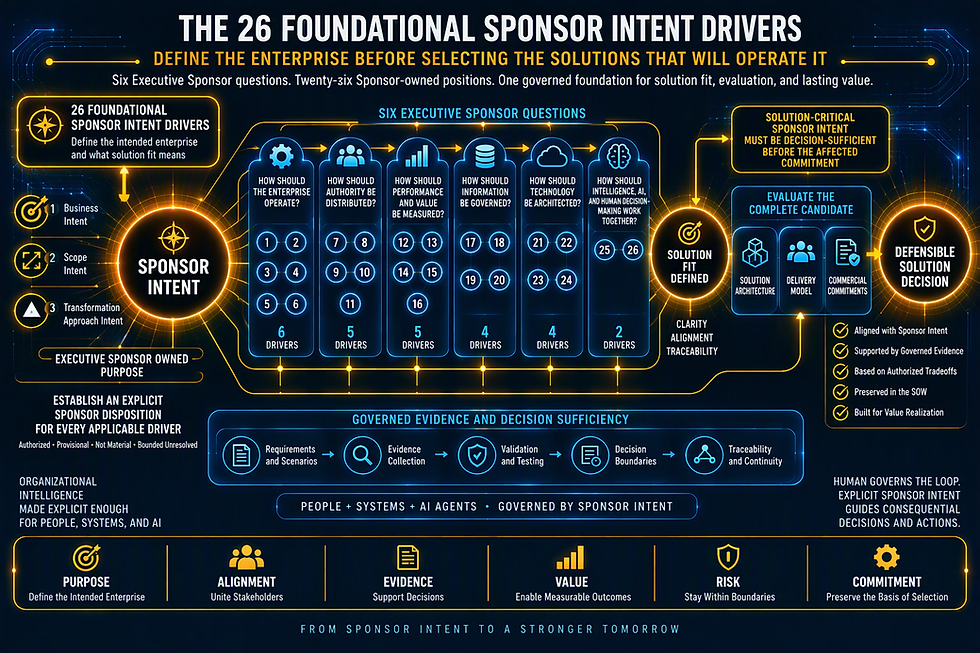
Six Executive Sponsor Questions. Twenty-Six Sponsor-Owned Positions. One Governed Definition of Enterprise Fit.
What Are Foundational Sponsor Intent Drivers?
Foundational Sponsor Intent Drivers are the Sponsor-owned positions concerning the operating model, management system, economics, information architecture, technology architecture, and enterprise intelligence architecture that materially influence ERP fit, implementation strategy, commercial commitments, governance requirements, and expected outcomes.
These positions are not inherently ERP-specific. They define foundational characteristics of the intended enterprise. ERP selection is one major application of the framework, but the same positions can guide CRM, data and analytics, automation, Agentic AI, and other consequential enterprise solution decisions. The applicable drivers and their relative consequence vary by solution class.
Each driver can shape hundreds of downstream decisions. The Sponsor’s standardization position can influence process design, configuration, data structures, governance, implementation effort, support requirements, upgradeability, and product suitability. The Sponsor’s AI ecosystem position can influence the preferred ERP, cloud platform, data architecture, automation strategy, and future agent ecosystem.
The 26 drivers establish a high-leverage foundation for the complete Sponsor Intent required by an Enterprise Transformation Program. They shape the downstream development of Business Intent, Scope Intent, Transformation Approach Intent, Sponsor Intent Assets, Meaning-Aligned Requirements, demonstration scenarios, evaluation criteria, implementation assumptions, and commercial commitments.
The Six Executive Sponsor Questions
Before ERP evaluation becomes consequential, the Executive Sponsor should establish decision-sufficient positions on six questions:
-
How should the enterprise operate?
-
How should authority be distributed?
-
How should performance and value be measured?
-
How should information be governed?
-
How should technology be architected?
-
How should intelligence, AI, and human decision-making work together?
These questions establish the meaning of ERP fit. The 26 Foundational Sponsor Intent Drivers organize the Sponsor-owned positions required to answer them.
1. How Should the Enterprise Operate?
ERP platforms operationalize a model of the enterprise. They connect people, processes, services, transactions, organizational units, and controls through a common architecture. Six Foundational Sponsor Intent Drivers establish the operating model the selected ERP and implementation approach must support.
1. Standardization Position
How much enterprise consistency does leadership expect, and where will governed variation remain appropriate?
The Executive Sponsor can favor a global template, governed localization, regional operating models, business-unit autonomy, or acquisition-specific flexibility. This position influences process design, data structures, controls, configuration, implementation cost, upgradeability, and the ability to adopt vendor-standard functionality.
2. Centralization and Decentralization Position
Where should decision authority reside?
This position determines which decisions belong at the enterprise, regional, business-unit, functional, or local level. It shapes organizational hierarchies, workflow design, approval authority, role security, escalation paths, reporting relationships, and exception governance.
3. Shared Services Position
Which activities should be performed through enterprise or regional shared services, and which should remain distributed?
Accounts payable, procurement administration, customer service, master data, payroll, finance operations, and IT services can follow different service-delivery models. The Sponsor’s position affects organization design, transaction routing, role structures, service management, deployment sequencing, and ERP economics.
4. Process Ownership Position
Who owns end-to-end processes, maintains their standards, resolves cross-functional conflicts, and approves material changes?
ERP processes cross traditional functional boundaries. Clear process ownership gives the enterprise an authoritative basis for resolving design choices and governing process evolution across functions, business units, and geographies.
5. Workforce and Organizational Change Position
What organizational behaviors must change, which practices should be preserved, and how much disruption is acceptable?
This position shapes implementation pace, role redesign, training, adoption expectations, local participation, workforce transition, and leadership involvement. It also establishes the organization’s readiness to make the operating changes required by a particular product and implementation model.
6. Acquisition Integration Position
How will current and future acquisitions be absorbed, connected, federated, standardized, or allowed to remain independent?
A growth-through-acquisition strategy can require rapid onboarding, flexible enterprise structures, multi-entity support, transitional operating models, and controlled coexistence. An enterprise pursuing immediate integration can prioritize a common operating template, shared data, consolidated processes, and centralized governance.
2. How Should Authority Be Distributed?
7. Governance Position
Which decisions are reserved for the Executive Sponsor or enterprise leadership, which are delegated, and which require escalation?
This position establishes the authoritative decision structure surrounding the ERP and the Enterprise Transformation Program. The selected product and implementation approach should reinforce the Sponsor’s intended governance architecture.
8. Exception Management Position
How will exceptions to enterprise standards be requested, approved, monitored, renewed, and retired?
Every ERP environment contains exceptions. A governed exception model gives each material variation named authority, a business rationale, supporting evidence, defined boundaries, review conditions, and an appropriate duration.
9. Pricing Position
Who possesses pricing authority, and how much discretion can be exercised by market, segment, channel, region, business unit, or local operation?
Pricing is both an authority decision and an economic decision. The ERP should support the intended balance among enterprise control, commercial responsiveness, customer differentiation, profitability, and local market knowledge.
10. Decision Participation Position
Which decisions require enterprise direction, Business-Side participation, local input, specialist review, or cross-functional authorization?
Participation influences accountability, decision quality, workflow design, adoption, and speed. This position helps the enterprise involve the right participants while preserving clear authority and timely decisions.
11. Escalation and Intervention Position
What conditions should trigger leadership attention, who can intervene, and what information must accompany an escalation?
This position determines how the management system responds when performance, risk, evidence, operating conditions, or exceptions move outside authorized boundaries. ERP workflow, reporting, alerting, and decision-support capabilities should reinforce that intervention model.
3. How Should Performance and Value Be Measured?
ERP platforms shape which results become visible, how economics are represented, and whether leadership can connect operating behavior to intended value. Five drivers establish the Sponsor’s management and economic model.
12. Performance Management Position
Which outcomes matter, how will accountability be assigned, what triggers intervention, and how should performance be reviewed?
The Executive Sponsor should define the relationship among intended outcomes, operating indicators, decision authority, accountability, and management action. The ERP can then support a management system designed around how leadership intends to govern performance.
13. Management Reporting Position
What visibility does leadership require across the enterprise?
This position defines the reporting hierarchies, dimensions, frequencies, definitions, and decision contexts the ERP must support. It establishes whether the information architecture reflects how leadership intends to manage the enterprise.
14. Profitability Measurement Position
How should profitability be evaluated across customers, products, services, channels, contracts, locations, projects, and business units?
ERP platforms differ in how naturally they support multidimensional economics, allocations, cost models, and revenue attribution. Those differences become meaningful when leadership defines which economic truths the management system must reveal.
15. Cost Allocation Position
Which costs should be directly assigned, allocated, pooled, transferred, or retained centrally?
Allocation choices influence product and customer profitability, shared-services economics, performance accountability, planning, intercompany arrangements, and operating behavior. The selected ERP should support the economic model the Executive Sponsor intends to govern.
16. Value Realization Position
How will the enterprise connect ERP-enabled capabilities to intended outcomes, operating changes, management actions, accountability, and evidence?
ERP value depends on process change, organizational behavior, management intervention, policy enforcement, data quality, and sustained adoption. The Value Realization Position establishes how leadership will connect those dependencies to the value the investment is expected to produce.
Capabilities are investments. Sponsor Intent is the governing definition of the value those investments are expected to deliver.
4. How Should Information Be Governed?
ERP selection establishes a consequential information architecture. The platform organizes the enterprise through records, hierarchies, definitions, dimensions, ownership structures, and reporting relationships. Four drivers define the Sponsor-owned foundation for that architecture.
17. Data Ownership Position
Who owns critical data, who can create or change it, who validates its quality, and who resolves competing definitions?
Data ownership affects master-data governance, workflow, controls, integration, reporting confidence, AI readiness, and operational accountability. Clear ownership provides the authority required to maintain trustworthy enterprise information.
18. Enterprise Structure Position
How should legal entities, business units, divisions, regions, locations, profit centers, cost centers, departments, projects, products, and customers be represented?
The enterprise structure becomes embedded across reporting, security, transactions, consolidations, planning, workflow, and integration. It should reflect how the organization intends to operate, assign accountability, and manage performance.
19. Chart of Accounts Position
How standardized should the chart of accounts be, and which local requirements must be accommodated?
The chart of accounts carries assumptions about standardization, accountability, visibility, consolidation, management reporting, and local autonomy. The Sponsor’s position should connect statutory, financial, managerial, and operational reporting requirements to the intended management system.
20. Organizational Intelligence Position
Which organizational knowledge should become explicit, authoritative, accessible, reusable, and governable for people, automation, and AI?
This includes business definitions, decision boundaries, exception rules, accountability requirements, evidence expectations, operating knowledge, and the rationale behind consequential decisions. The Organizational Intelligence Position establishes how the enterprise will preserve the meaning required to guide human and increasingly autonomous action.
Making Organizational Intelligence Explicit Enough for AI.
5. How Should Technology Be Architected?
Enterprise solutions increasingly operate as components within a broader architecture spanning transactional platforms, specialized applications, data, analytics, integration, automation, AI, and agents. Four drivers establish how that architecture should be composed and the intended role of ERP and other major platforms within it.
21. Customization Position
How much customization is acceptable, where is differentiation valuable, and where should the enterprise adopt standard product behavior?
A clean-core strategy, selective extension strategy, industry-specific model, and highly tailored platform create different implications for fit, implementation effort, upgradeability, support, risk, and long-term economics. The Sponsor’s position provides the basis for governing those tradeoffs.
22. Integration Position
Which systems should exchange information, where should orchestration occur, who owns the integration logic, and how much complexity is acceptable?
Integration strategy determines whether the ERP becomes the architectural center or one governed component within a broader ecosystem. It also affects implementation effort, data ownership, reliability, change control, resilience, and Total Cost of Ownership.
23. Solution Landscape Position
Does leadership intend to consolidate around a suite, adopt best-of-breed applications, establish a hybrid architecture, or organize around a strategic platform ecosystem?
This position defines the intended number, role, and relationship of major platforms and specialized components. It determines where ecosystem coherence across applications, identity, data, integration, analytics, automation, AI, security, governance, and future agents creates material enterprise value, and where differentiated capability justifies introducing another architectural boundary. Improving connectivity does not eliminate the need to govern business meaning, data authority, permissions, dependencies, accountability, evidence, operational complexity, and Total Cost of Ownership across those boundaries.
The best individual component does not necessarily produce the strongest complete solution.
24. Deployment and Resilience Position
What deployment, availability, performance, security, sovereignty, continuity, recovery, and resilience requirements must the architecture support?
These requirements flow from the enterprise’s operating model, regulatory environment, geographic footprint, transaction profile, and risk tolerance. Defining them early gives the organization an authorized basis for evaluating vendor architectures and implementation assumptions.
6. How Should Intelligence, AI, and Human Decision-Making Work Together?
ERP selection is becoming an enterprise intelligence decision. The platform’s AI ecosystem, data architecture, semantic model, automation capabilities, development roadmap, agent strategy, and relationship to human authority increasingly influence long-term fit. The final two drivers establish the Sponsor-owned foundation for that intelligence architecture.
25. AI Ecosystem and Agent Strategy Position
How important is ecosystem coherence across ERP, cloud, data, analytics, productivity, automation, AI, and future agents?
The Executive Sponsor should determine whether the enterprise has a preferred cloud platform, AI ecosystem, semantic architecture, development environment, productivity environment, or agent strategy. The selection increasingly encompasses the broader intelligence ecosystem surrounding the ERP.
26. AI Delegation and Human Governance Position
Which decisions can AI prepare, recommend, execute, monitor, or escalate? Which decisions require human authorization? What boundaries, exception rules, evidence expectations, and accountability requirements govern delegated authority?
This position defines how intelligence participates in the operating and management systems. It gives the enterprise an explicit delegation model for determining where AI can act, when human authorization is required, which evidence must be preserved, and who remains accountable.
Human governs the loop.
AI increases the strategic importance of every preceding driver. AI can reinforce standards, exercise delegated authority, monitor exceptions, generate management reporting, coordinate workflows, and recommend action. Its value depends on the quality of the Sponsor-owned positions governing those activities.
People compensated for ambiguity. Autonomous agents amplify it.
The 26 Drivers Operate as a System
The Foundational Sponsor Intent Drivers should be evaluated through their dependencies. A Sponsor who favors enterprise standardization while preserving broad local pricing authority has defined a deliberate tension the ERP must support. A shared-services strategy affects workforce roles, process ownership, data ownership, reporting, service management, and deployment sequencing.
A suite-led technology strategy influences integration, customization, data governance, AI ecosystem choices, and Total Cost of Ownership. An AI delegation position depends on clear authority, exception management, data ownership, organizational intelligence, and evidence requirements. The strongest definition of ERP fit emerges from the relationships among the 26 positions.
An Executive Sponsor could authorize a combination such as:
-
A global operating template
-
Federated commercial authority
-
Enterprise shared services for finance
-
Local customer and pricing decisions
-
Global process ownership
-
Governed regional exceptions
-
Central data standards
-
Common management reporting
-
Selective platform extensions
-
A preferred AI and agent ecosystem
Together, these positions create a distinct definition of fit. That definition can govern demonstration scenarios, evaluation criteria, gap analysis, implementation assumptions, commercial comparisons, the SOW, and material commitments.
Define the Drivers to a Decision-Sufficient Level
Executive Sponsors are expected to develop the 26 positions progressively. Initial positions can be partial, inherited, conflicting, or supported by limited evidence. Business Intent Design provides the discipline for discovering, clarifying, testing, authorizing, and governing them.
Decision sufficiency is the governing threshold. Before each consequential commitment, the organization should define enough Sponsor Intent to make the decision responsibly and understand the implications. The substantial majority of Sponsor Intent that materially affects ERP fit, scope, implementation approach, responsibilities, estimates, commercial commitments, validation, and expected value should reach a decision-sufficient level before the SOW is signed.
For each relevant Foundational Sponsor Intent Driver, discovery should establish:
-
The Executive Sponsor’s current position
-
Why the position matters
-
Which intended outcomes it supports
-
Which decisions depend on it
-
Which boundaries and exceptions apply
-
Which evidence supports or challenges it
-
Which risks arise while it remains unresolved
-
Whether it should become an authorized Sponsor Intent Asset
-
How it will shape solution selection, the SOW, implementation, validation, Value Realization, and Operations
The positions continue to develop as evidence accumulates and operating conditions change. Sponsor Intent Lifecycle Management keeps them reviewable, governable, traceable, and durable throughout the Enterprise Transformation Program lifecycle.
Turn Product Demonstrations into Tests of Fit
Once the relevant drivers are sufficiently defined, demonstrations become structured tests of Sponsor Intent. The Business-Side team can design scenarios around the intended operating model, distribution of authority, management system, information architecture, technology architecture, and enterprise intelligence architecture.
A Sponsor-controlled demonstration can test whether a candidate supports:
-
Enterprise standards with governed regional exceptions
-
Central policy authority with local commercial discretion
-
Global process ownership
-
Regional shared services
-
Enterprise data standards
-
Local statutory requirements
-
Common management reporting
-
Product and customer profitability
-
A suite-led integration strategy
-
Human-governed AI delegation
-
Traceable evidence supporting value realization
The organization can then determine where the candidate naturally reinforces Sponsor Intent, where configuration is required, where an extension is justified, where operating change creates value, and where a material gap requires an explicit tradeoff decision.
The demonstration becomes evidence.
Connect Every Material Claim to Evidence
A defensible ERP decision connects material evaluation criteria to authorized Sponsor positions. Vendor claims should be supported by evidence appropriate to their consequence, including configured demonstrations, reference architectures, product documentation, roadmap commitments, comparable customer references, implementation estimates, prototypes, security analysis, Total Cost of Ownership analysis, and commitments preserved in the SOW.
A score shows how an option was rated. Governed evidence explains why the conclusion should be trusted, what assumptions support it, which dependencies remain, and which tradeoffs the Executive Sponsor has authorized.
The Foundational Sponsor Intent Drivers determine which evidence matters.
The 26 Drivers Define Fit
The 26 Foundational Sponsor Intent Drivers define the intended enterprise at a foundational level. Sponsor Intent establishes the complete governing standard through Business Intent, Scope Intent, and Transformation Approach Intent. Meaning-Aligned Requirements translate that governing standard into required capabilities, behaviors, boundaries, and evidence expectations.
The 15 Solution Selection Criteria then evaluate the complete candidate. The complete candidate can include the primary platform, supporting applications and services, implementation partner, implementation approach, data and integration architecture, intelligence and agent capabilities, commercial structure, SOW, governance conditions, evidence model, validation readiness, economic exposure, assumptions, dependencies, risks, and organizational commitments. Category-specific evaluation factors determine the additional evidence required for ERP, CRM, data and analytics, Agentic AI, or another solution class.
The 26 drivers define the enterprise the solution must fit. The 15 Solution Selection Criteria evaluate whether the complete candidate can operationalize Sponsor Intent.
From Sponsor Position to Enterprise Commitment
The governing sequence connects the Executive Sponsor’s earliest positions to the final investment decision and the Enterprise Transformation Program that follows:
-
The 26 Foundational Sponsor Intent Drivers help define the intended enterprise.
-
Sponsor Intent establishes the complete governing standard through Business Intent, Scope Intent, and Transformation Approach Intent.
-
Sponsor Intent Assets preserve authorized positions, rationale, boundaries, validation requirements, and evidence expectations.
-
Meaning-Aligned Requirements translate Sponsor Intent into required capabilities, behaviors, boundaries, and evidence.
-
Sponsor-controlled demonstrations test candidates within the Sponsor’s business context.
-
Governed Selection Evidence establishes what each candidate has credibly demonstrated.
-
The 15 ERP Software Selection Criteria evaluate the complete candidate.
-
Governing Tradeoff Decisions protect mandatory conditions and Sponsor-owned priorities.
-
The SOW converts material selection commitments into enforceable obligations.
-
Implementation readiness confirms that the authorized decision can responsibly move into implementation.
-
Lifecycle continuity preserves the basis of selection through implementation, Value Realization, and Operations.
Define fit through Sponsor Intent. Test fit through evidence. Evaluate the complete candidate. Preserve the basis of selection through the SOW and implementation.
Operationalized Through The CFO-TA
The CFO-TA is the Executive Sponsor Platform. It helps Executive Sponsors govern their three Sponsor-owned responsibilities: Business Intent, Scope Intent, and Transformation Approach Intent. Together, these form Sponsor Intent, the Executive Sponsor-owned expression of purpose and foundation of the Transformation Definition.
The CFO-TA supports guidance, methodology, authoring, analysis, deliverable production, validation, review, coordination, decision support, continuity, and Sponsor Intent Lifecycle Management across the Enterprise Transformation Program lifecycle. Its discovery capabilities guide Executive Sponsors and Business-Side teams through the relevant Foundational Sponsor Intent Drivers, identify dependencies, surface unresolved tensions, preserve evidence, and progressively convert Sponsor positions into governed Sponsor Intent Assets.
The SILMS preserves those assets as an authoritative Business-Side reference. The resulting governed artifact chain connects the Sponsor-owned positions used to define ERP fit with what the enterprise evaluates, selects, commits to, implements, validates, and operates.
Intent Governance Preserves the Definition of Fit
Intent Governance governs purpose. Execution Governance governs behavior.
Intent Governance addresses both the enduring challenge of transformation drift and the emerging requirements of Agentic AI. It preserves authoritative Sponsor Intent as decisions, participants, assumptions, and operating conditions change. It also makes intended outcomes, priorities, boundaries, accountabilities, validation requirements, and evidence expectations explicit enough to guide increasingly autonomous execution.
People compensated for ambiguity. Autonomous agents amplify it.
The Foundational Sponsor Intent Drivers establish the purpose-defining positions that should govern solution selection. Execution Governance carries those positions into configurations, workflows, controls, implementation decisions, validation activities, and operations. Connecting both forms of governance from the beginning gives the Executive Sponsor a durable line of sight from intended enterprise to operational result.
Next Steps
ERP selection becomes consequential before the shortlist, request for proposal, requirements inventory, or product demonstration. It begins when the Executive Sponsor determines how the enterprise should operate, where authority should reside, how performance and value should be measured, how information should be governed, how technology should be architected, and how intelligence, AI, and human decision-making should work together.
The 26 Foundational Sponsor Intent Drivers make those positions visible, discussable, testable, and governable. They give the Business-Side team a stronger basis for designing demonstrations, evaluating tradeoffs, challenging estimates, comparing Total Cost of Ownership, defining the SOW, and holding the final selection accountable to the enterprise the Sponsor intends to create.
The first product demonstration should test the definition of fit.
About Alentra Advisory
Alentra Advisory helps Executive Sponsors establish, preserve, challenge, validate, monitor, improve, reaffirm, revise, and prove the purpose of major transformation investments.
Business Intent Design helps Executive Sponsors progressively define Sponsor Intent before consequential contractual commitments are made. Sponsor Intent is formed by Business Intent, Scope Intent, and Transformation Approach Intent and serves as the Executive Sponsor-owned expression of purpose and foundation of the Transformation Definition. Intent Governance preserves and governs that purpose as decisions, participants, assumptions, evidence, and operating conditions change.
The CFO-TA is the Executive Sponsor Platform. It supports Executive Sponsors and Business-Side teams through guidance, methodology, authoring, analysis, deliverable production, validation, review, coordination, decision support, continuity, and Sponsor Intent Lifecycle Management across the Enterprise Transformation Program lifecycle.
The Sponsor Intent Lifecycle Management Studio (SILMS) provides the major platform capability used to establish, preserve, challenge, validate, monitor, improve, reaffirm, revise, and prove Sponsor Intent throughout the Enterprise Transformation Program lifecycle and ongoing operations. Human Decision Authorities retain accountability for selection decisions, risk acceptance, tradeoffs, financial judgments, validation conclusions, and authorization.