
The Alentra Transformation Methodology
Maintaining Business Intent Across the Enterprise Transformation Lifecycle
The Alentra Transformation Methodology provides a structured lifecycle for maintaining alignment between leadership intent and operational reality.
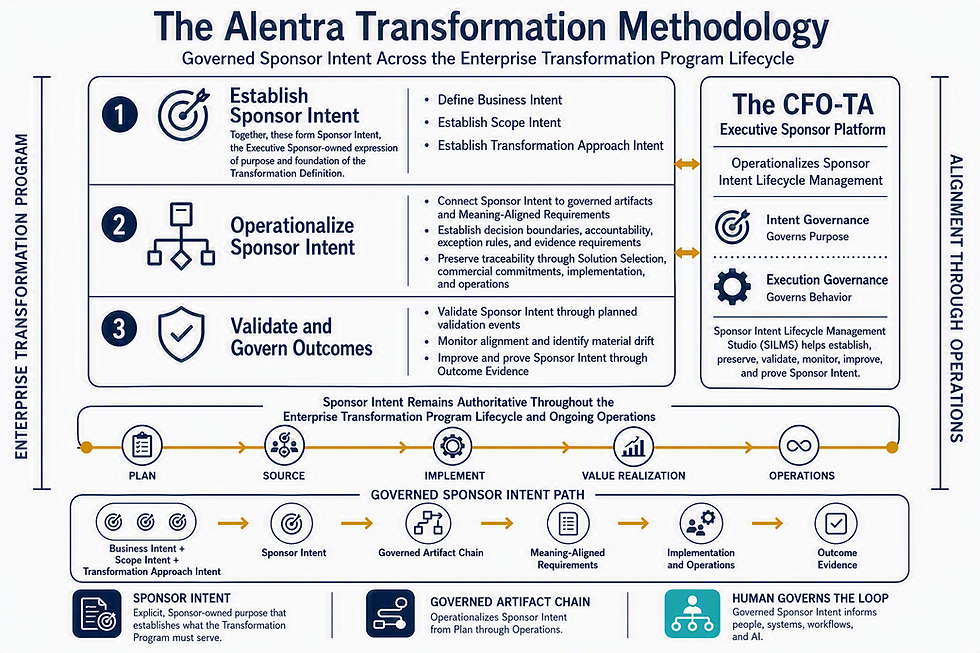
It helps Sponsors and Business-Side leaders make consequential Sponsor Intent explicit before implementation decisions begin moving at delivery speed. It then connects that Sponsor Intent to requirements, decisions, configuration, validation, evidence, outcomes, and ongoing operations.
The methodology applies across AI-enabled ERP, CRM, analytics, data, and operational transformations. It also supports the ongoing stewardship of Sponsor Intent as systems enter operations, AI capabilities evolve, business conditions change, and new decisions are made.
Intent Governance is the foundational discipline within the methodology.
The Alentra Transformation Methodology defines how Intent Governance is applied throughout the Enterprise Transformation Program and Sponsor Intent lifecycles.
The CFO-TA is the Executive Sponsor Platform that enables organizations to put the methodology into practice. It is a Business-Side platform purpose-built for Executive Sponsors responsible for major transformation investments.
Sponsor Intent is the Executive Sponsor-owned expression of purpose and the foundation of the Transformation Definition. It is formed by Business Intent, Scope Intent, and Transformation Approach Intent. Business Intent Design is the discipline used to define, validate, and govern Sponsor Intent before contractual commitments are made. The methodology provides the structure through which Sponsor Intent is established, preserved, validated, monitored, improved, and proven throughout the Enterprise Transformation Program lifecycle.
Why This Methodology Exists
Many transformations begin with a strategy, business case, or executive mandate. These may establish direction, but they rarely provide a sufficiently governed and actionable foundation for governing the thousands of decisions that follow.
As leadership intent moves through requirements, design, configuration, implementation, testing, deployment, and operations, its meaning can become open to interpretation. Assumptions enter the process. Priorities shift. Business definitions diverge. Delivery pressures influence decisions. Exceptions are introduced without fully tracing their consequences.
The resulting systems may operate as configured while producing outcomes that differ from what leadership intended.
Organizations manage Transformation Programs, requirements, scope, risks, controls, and technology. Far fewer actively govern the purpose those activities are intended to serve.
Most transformations do not drift because organizations lack strategy, governance, requirements, testing, capable implementation teams, or committed leadership. They drift because Sponsor Intent is repeatedly interpreted as work moves from leadership through design, implementation, operations, and AI-enabled workflows. Over time, those interpretations accumulate and operations drift from what leadership originally intended. Historically, people absorbed much of that ambiguity. AI cannot.
The Alentra Transformation Methodology addresses this structural gap by helping organizations transform strategic intent into governed Sponsor Intent that remains authoritative throughout the Enterprise Transformation Program lifecycle.
The methodology does not attempt to replace delivery methods, implementation partners, Transformation Program management, architecture, legal advice, risk management, compliance, or operational expertise. It provides the Sponsor-Side discipline needed to keep those activities aligned with what leadership approved.
What the Methodology Governs
The methodology focuses on Sponsor Intent, the Executive Sponsor-owned expression of purpose that teams, systems, workflows, implementation partners, and AI are expected to serve.
Depending on the operating domains and Transformation Program activities in scope, the governed Sponsor Intent may include:
-
Intended Business Outcomes
-
Conditions of Success
-
Core Business Definitions
-
Governing principles
-
Decision boundaries
-
Accountability requirements
-
Exception rules
-
Evidence requirements
-
Sponsor Intent Assets (SIAs)
-
Meaning-Aligned Requirements
-
Validation expectations
-
Monitoring expectations
-
Authorization requirements
The methodology does not seek to document every process detail, system behavior, or operational activity. It concentrates on the Sponsor Intent that is sufficiently consequential to require explicit ownership, governance, traceability, validation, and ongoing stewardship.
Sponsor Intent is designed before implementation, governed as decisions are made, validated through planned events, preserved through governed artifacts, and intentionally evolved when leadership or material conditions require change.
These activities are applied throughout the Enterprise Transformation Program lifecycle rather than presented as a separate lifecycle or methodology structure.
As organizations become increasingly dependent on AI-enabled processes, intelligent agents, and autonomous workflows, the operational details that humans once understood implicitly must be defined explicitly. Sponsor Intent can no longer remain fragmented across presentations, requirements, meeting discussions, spreadsheets, tribal knowledge, and individual interpretations. It must be intentionally designed, governed, validated, preserved, and evolved throughout its lifecycle.
The Enterprise Transformation Program Lifecycle

The four phases every ERP transformation must navigate.
The Alentra Transformation Methodology is organized around four connected Transformation Program phases, followed by Operations.
The four Transformation Program phases are:
-
Plan
-
Source
-
Implement
-
Value Realization
Operations follows the Transformation Program and provides the continuing context in which approved Sponsor Intent must remain relevant, authoritative, and capable of evolving.
This is why the methodology treats Sponsor Intent as a continuous governance responsibility rather than a one-time Transformation Program activity.
Plan Phase
The Plan Phase establishes why the Transformation Program exists, what leadership intends to achieve, which operating domains are involved, and what must remain true as the organization moves forward.
This phase may include Transformation Strategy, Business Intent Design, intended Business Outcomes, Conditions of Success, scope boundaries, Core Business Definitions, accountability requirements, decision boundaries, exception rules, evidence expectations, readiness considerations, and the initial Sponsor Intent foundation encompassing Business Intent, Scope Intent, and Transformation Approach Intent.
The objective is to make the most consequential Sponsor Intent explicit before solution decisions, delivery commitments, or implementation assumptions constrain the organization’s choices.
The Plan Phase creates the authoritative foundation against which subsequent decisions can be governed.
Source Phase
The Source Phase connects approved Sponsor Intent to the evaluation and selection of solutions and implementation partners.
Meaning-Aligned Requirements, evaluation criteria, solution demonstrations, partner assessments, commercial decisions, and selection recommendations are governed against the Sponsor Intent established during the Plan Phase.
This helps ensure that solutions and partners are evaluated against what the organization intends to achieve rather than against vendor-defined narratives, isolated feature comparisons, or assumptions that have not been authorized by the Sponsor.
The Source Phase preserves the relationship between approved Sponsor Intent and the solution and partner choices that will materially shape implementation.
By establishing Sponsor Intent before vendor demonstrations, Solution Selection, procurement, contracting, and implementation activities begin, organizations can evaluate alternatives more effectively, negotiate from a more informed position, reduce avoidable rework, improve transformation economics, and increase the likelihood that outcomes remain aligned with leadership objectives.
Implement Phase
The Implement Phase maintains alignment between approved Sponsor Intent and the decisions made during design, configuration, integration, testing, deployment, adoption, and change management.
The methodology helps make material decisions, exceptions, accountabilities, evidence expectations, and Sponsor authorization requirements explicit. It provides traceability between Sponsor Intent, Meaning-Aligned Requirements, implementation decisions, configuration choices, validation activities, findings, and dispositions.
Implementation partners remain responsible for implementation. The Sponsor and Business-Side leaders remain responsible for Sponsor Intent, priorities, boundaries, accountability, exceptions, and authorization decisions.
This Segregation of Duties helps protect Sponsor authority while giving delivery teams clearer direction and more stable decision boundaries.
Value Realization Phase
The Value Realization Phase determines whether the intended Business Outcomes and Conditions of Success have been achieved.
Outcome Evidence and Business Intent Testing (BIT) provide the basis for assessing whether the Transformation Program produced the results leadership authorized. Sponsor Intent Validation Plans (SIVPs) define the planned validation approach, and Sponsor Intent Test Cases (SITCs) provide the individual validation activities used during planned validation events.
Findings are reviewed, dispositions are recorded, unresolved matters are assigned accountable ownership, and outcome claims are supported by defined evidence rather than narrative confidence alone.
The Value Realization Phase does not treat deployment or technical completion as proof of business value. It focuses on whether the outcomes that justified the Transformation Program have been demonstrated.
Operations
Operations begins after the Transformation Program moves into sustained use.
Systems, AI capabilities, business processes, operating models, policies, organizational priorities, and external conditions continue to change. These changes may affect the Sponsor Intent established during the Transformation Program.
The methodology helps leadership monitor for drift, identify material changes, maintain accountability, review new evidence, govern exceptions, and authorize changes to Sponsor Intent where appropriate.
Operations is not a fifth Transformation Program phase. It is the continuing operating context in which the Sponsor Intent established and validated through the Transformation Program must be preserved and intentionally evolved.
This distinction allows the Transformation Program to have a defined lifecycle while recognizing that Sponsor Intent remains relevant after the program concludes.
As AI adoption increases, preserving alignment between Sponsor Intent and operational reality becomes even more important because AI executes and amplifies whatever meaning has been established.
Business Intent as the Connecting Foundation
Approved Sponsor Intent provides the connecting foundation across the Enterprise Transformation Program lifecycle.
During Plan, leadership establishes Business Intent, Scope Intent, Transformation Approach Intent, Business Outcomes, Conditions of Success, Core Business Definitions, boundaries, accountability requirements, exception rules, and evidence expectations that should guide the Transformation Program.
During Source, that foundation informs Meaning-Aligned Requirements, evaluation criteria, solution demonstrations, partner assessments, and selection decisions.
During Implement, it provides the authoritative reference for design, configuration, integration, testing, deployment, adoption, exceptions, and Sponsor authorization decisions.
During Value Realization, Business Intent Testing, planned through the Sponsor Intent Validation Plan and performed through Sponsor Intent Test Cases, together with Outcome Evidence, helps determine whether the Transformation Program produced the outcomes leadership authorized.
When the solution moves into Operations, the approved Sponsor Intent foundation continues to guide monitoring, improvement, accountability, exceptions, and authorized change.
The detailed methods and artifacts used to establish and operationalize this foundation are introduced on the Business Intent Design page.
>> Explore Business Intent Design

Sponsor Authority and Separation of Duties
The Alentra Transformation Methodology is intentionally Business-Side.
Sponsors and Business-Side leaders retain authority over Sponsor Intent, priorities, boundaries, accountability, exceptions, evidence expectations, and authorization decisions.
Implementation partners remain responsible for designing, configuring, integrating, testing, and deploying the selected solution. Operational functions remain responsible for running business processes and controls. Legal, Risk, Compliance, Privacy, Security, and Audit retain authority within their respective domains.
Alentra helps the Sponsor apply the methodology independently and consistently.
This creates an important Segregation of Duties between those responsible for implementation and those responsible for governing alignment to approved Sponsor Intent.
The CFO-TA helps organizations make better transformation decisions before they become contractual commitments, implementation work, operating procedures, or AI behaviors.
The same organization responsible for implementation should not be the sole authority determining whether its work remains aligned with what leadership authorized.
This Segregation of Duties is one of the defining characteristics of an independent Business-Side Intent Governance approach.
Segregation of Duties strengthens transparency, accountability, evidence quality, and the credibility of validation without transferring implementation responsibility to Alentra.
Application in Regulated Environments
The Alentra Transformation Methodology can incorporate conditional regulatory outputs when laws, standards, contractual requirements, or industry obligations apply.
These outputs help connect client-determined obligations to Sponsor Intent, accountability, decision boundaries, evidence requirements, validation activities, and downstream requirements. They are informed and validated by the client’s accountable Legal, Risk, Compliance, Privacy, Security, and Audit functions.
The CFO-TA does not independently determine regulatory applicability, provide legal interpretation, perform compliance execution, or certify an organization, system, process, control, or AI capability.
Its role is to help make applicable Sponsor Intent, authority, boundaries, decisions, validation expectations, and evidence requirements explicit and traceable throughout the Enterprise Transformation Program lifecycle.
>> Explore The CFO-TA in Regulated Environments
What the Methodology Produces
The specific outputs of the Alentra Transformation Methodology depend on the operating domains, Transformation Program phases, and scope selected.
The methodology establishes a Sponsor-owned foundation that may include Transformation Strategy, approved Sponsor Intent, Meaning-Aligned Requirements, solution and partner evaluation structures, implementation governance records, planned validation activities, Outcome Evidence requirements, findings, dispositions, authorizations, and ongoing monitoring and improvement records.
These outputs are connected through traceability rather than managed as isolated documents. Together, they provide a governed record of what leadership intended, how that intent informed consequential decisions, how alignment was validated, and whether the authorized outcomes were achieved.
For detailed descriptions of Sponsor Intent Assets (SIAs), Meaning-Aligned Requirements, the Business Intent Control Path, Sponsor Intent Validation Plans (SIVPs), Sponsor Intent Test Cases (SITCs), Business Intent Testing (BIT), and Outcome Evidence.
>> Explore Deliverable Portfolio
Governed Sponsor Intent Across the Enterprise Transformation Lifecycle
The Alentra Transformation Methodology provides more than a sequence of transformation activities.
It establishes a governed way to connect leadership intent to operational reality across Plan, Source, Implement, Value Realization, and Operations.
By designing Sponsor Intent before implementation, governing it as decisions are made, validating it through planned events, preserving it through governed artifacts, and evolving it under accountable authority, organizations can maintain alignment without reducing governance to bureaucracy or allowing implementation and operations to redefine purpose.
The result is a living, Sponsor-owned foundation of governed Sponsor Intent that can guide the Transformation Program from initial planning through value realization and remain authoritative as the organization moves into ongoing operations.
Sponsor Intent Lifecycle Management Studio (SILMS) is a major capability of The CFO-TA used to establish, preserve, validate, monitor, improve, and prove Sponsor Intent. A governed artifact chain operationalizes Sponsor Intent throughout the Enterprise Transformation Program lifecycle.
Intent Governance governs purpose. Execution Governance governs behavior. The CFO-TA supports both by preserving the relationship between what the Executive Sponsor intends and how the Transformation Program is implemented and operated.
The CFO-TA exists because Sponsor Intent should shape vendor demonstrations, Solution Selection, commercial commitments, implementation, operations, and AI behavior from the beginning of the Enterprise Transformation Program lifecycle and remain authoritative throughout it.
Next Steps
>> Return to The CFO-TA Platform
>> Review How We Engage to determine the right engagement model for your situation